How it works,
end to end.
b/cited turns 90 days of Google Search Console data plus daily AEO citation runs into a single map of where you stand in both classic search and AI answer engines. Each section below walks through one surface in the dashboard — what it shows, what it draws from, and which plan it's on.
Connect Google Search Console
Sign in with Google. The OAuth flow requests a single sensitive scope: webmasters.readonly — read-only access to Search Console data on the properties you've verified. Nothing else. No write access, no other APIs, no analytics.
Pick a verified property. b/cited pulls the last 90 days of query + page impression data, the most recent calendar month's URL-level metrics, and the property's verification status. Total time from sign-in to first dashboard view is usually under five minutes.
Free and Solo cover 1 property. Pro covers 5, Agency covers 10 — the picker at /p/new is multi-select, so onboarding a portfolio is one pass.
The encrypted refresh token lives in Cloudflare D1, encrypted with AES-GCM using a key in Cloudflare's secret store. It's used to refresh access on subsequent syncs and for nothing else. Full detail in the privacy policy.
Topical clusters
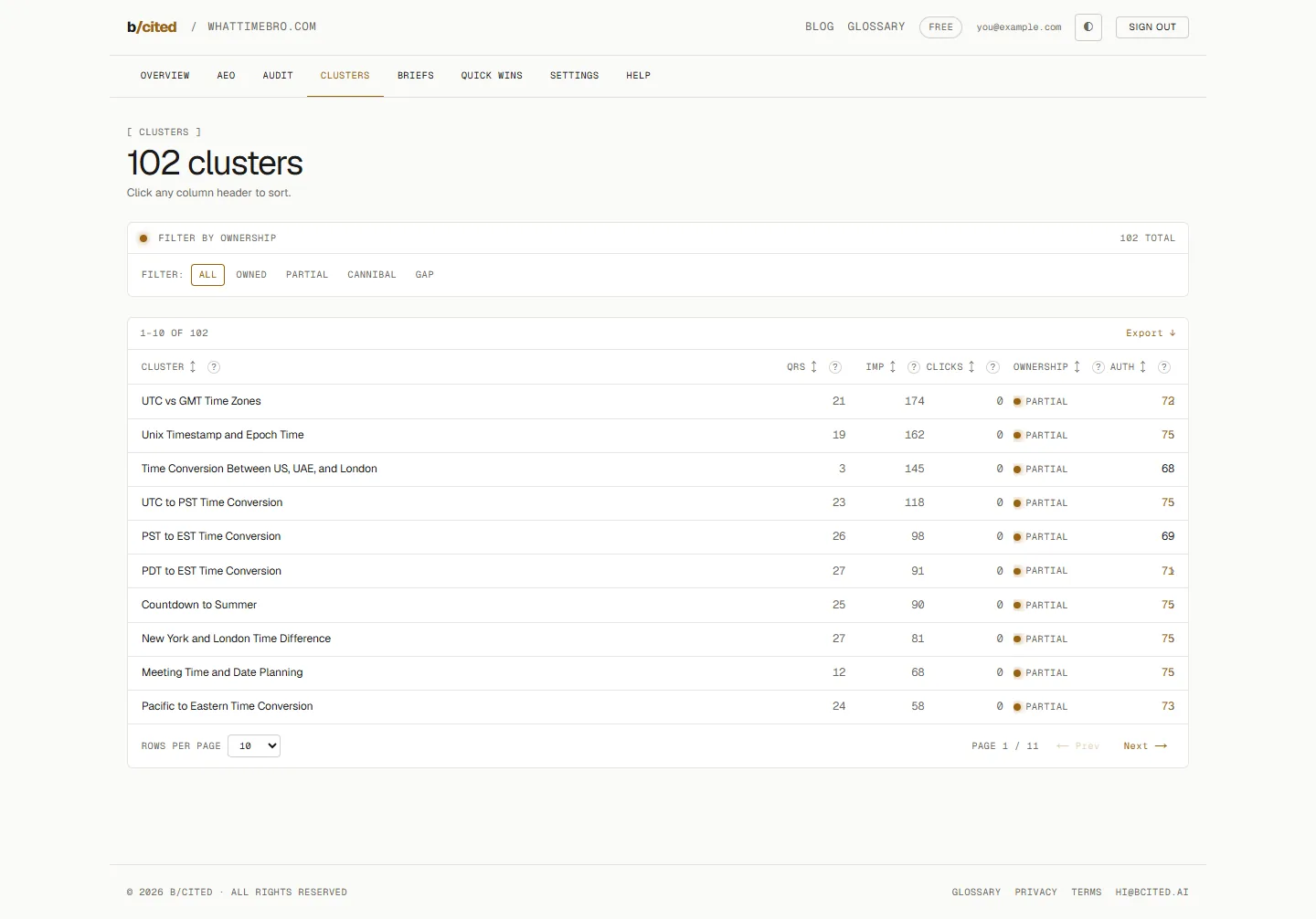
Each query the property pulled gets embedded via OpenAI's text-embedding-3-small (1536 dimensions) and stored in Cloudflare Vectorize. A centroid-greedy clustering pass groups semantically related queries — "schema markup setup" and "structured data implementation" end up in the same cluster even though they share no exact words.
For each cluster, the dashboard surfaces:
- Cluster label (LLM-generated from the top queries)
- Member count + sample queries
- Total impressions, clicks, average position, CTR
- Ownership status — which page on your site (if any) currently ranks; ranking depth across the cluster
- Authority score — composite metric weighting impressions × position × CTR × ownership coherence
This is the structural map. Every other surface — briefs, quick wins, internal-link suggestions — draws from it. Pro and Agency add a 3D rendering of the same map for spotting neighbourhood structure at a glance.
AEO citation tracking
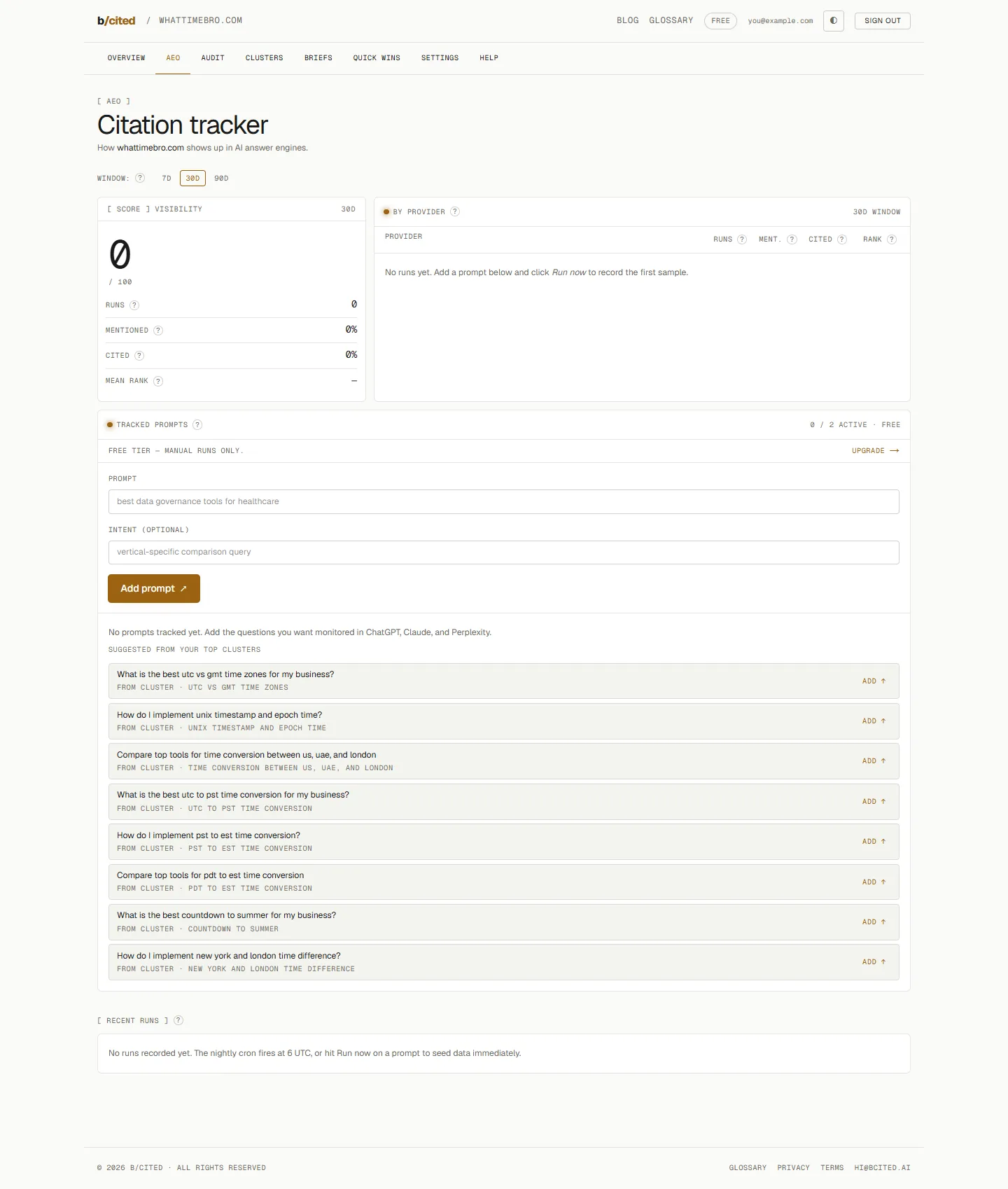
Define a set of tracked prompts — questions a prospective customer might type into ChatGPT, Claude, or Perplexity.
For each run, the citation extractor parses the model response and detects:
- Whether your domain appears in the citation list (the "cite" signal)
- Whether your brand is mentioned in the body without linking (the "mention" signal)
- Citation position when present
- Which competitor domains were cited instead
- The raw answer text, stored for audit
All three signals roll into a per-engine Visibility Score (0–100) and an overall score weighted across providers. Competitor leaderboards show which other brands consistently beat you to citation on the same prompts — the AEO-shaped answer to "who's eating my lunch in this conversation?"
Cadence is the tier difference that matters most. Free gives you 5 prompts run on request, which is enough to see the surface work. Every paid tier runs every tracked prompt against all three providers automatically each day — 25 prompts on Solo, 75 on Pro, 250 on Agency. Citation results are noisy day to day, so a manual snapshot tells you much less than it appears to; a daily series is what turns this into a rate you can watch move.
Content briefs
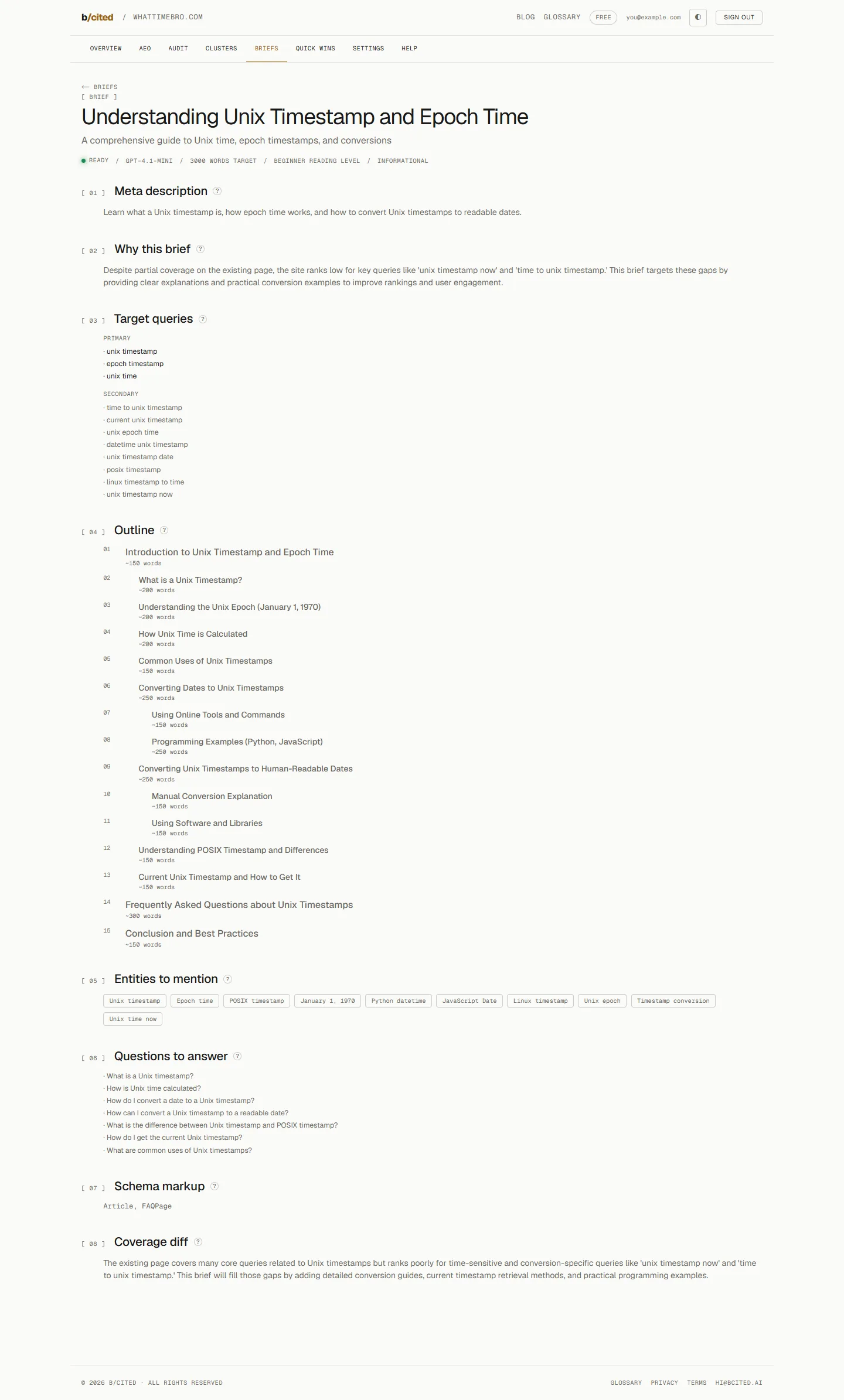
Briefs are the editorial output the dashboard exists to produce. Each brief targets one underserved cluster or content gap and includes:
- The target query set (3-8 queries with shared intent)
- Suggested page structure (H1, H2 sequence, FAQ block, examples)
- Schema types to embed (Article, FAQPage, HowTo, BreadcrumbList depending on intent)
- Internal-link targets — which existing pages on your site should link in, which should link out
- Competitor pages currently ranking, with notes on what's missing from each
- EEAT signals to lean into (author byline, primary-source citations, structured author credentials)
Briefs aren't AI-written copy. They're an editorial outline — the planning layer between data and a real writer (you, your team, a contractor). The pattern is: ingest the data once, generate briefs against it, ship pages, re-ingest in 4–6 weeks to measure.
Allowances are monthly and reset on the 1st: 3 on Free, 10 on Solo, 50 on Pro, unlimited on Agency.
Article writer
Any brief in the ready state can be handed to the article writer, which produces a complete first draft against the brief's own outline — target queries, heading structure, entities to mention, questions to answer — and stores it as Markdown and HTML you can download.
It writes from the brief, not from a prompt, which is the reason it's worth using: the outline was derived from your Search Console data and your competitors' citation patterns, so the draft starts aimed at a gap you actually have rather than at a topic in general.
Pro includes 20 drafts per month; Agency is uncapped. Free and Solo stop at the brief — which is the deliberate line, because the brief is the part that needs your data and the draft is the part that needs your voice.
Site Readiness Audit
A 9-category audit producing an A-F letter grade and a full finding list per check:
- Indexing — robots.txt, sitemap, canonical, X-Robots-Tag, noindex
- Metadata — title, description, lang, viewport, H1
- Social — Open Graph, Twitter Card completeness
- Schema — JSON-LD presence, Organization / BreadcrumbList / SearchAction coverage
- AEO — llms.txt, ai.txt, AI crawler stance, FAQPage / HowTo / Author schema — the category competitors don't have
- Security — HSTS, X-Frame-Options, CSP, Referrer-Policy, Permissions-Policy
- International — hreflang annotations, language variants
- Mobile — viewport meta, theme-color, apple-touch-icon, manifest
- Performance — Core Web Vitals via Google PageSpeed Insights
Available as an anonymous public scan (no sign-in, IP-rate-limited, and it never counts against a project's allowance) and as a per-project audit inside the dashboard, where the history page plots the grade over time so a regression after a deploy is visible at a glance.
Per-project audits are metered monthly: 1 on Free, 2 on Solo, and unlimited on-demand runs on Pro and Agency. Agency additionally runs one automatically against every project on the 1st of each month.
White-label cards + monthly reports
Every paid tier gets a shareable public Visibility Card — a /share/[token] URL showing a project's headline score and per-provider breakdown, with no prompts, email address, or Search Console property exposed. Two things are Agency-only on top of that:
- White-label those cards — override the agency name, logo (R2-stored, ≤200KB), and accent colour. The URL stays the same, the chrome becomes yours. Solo and Pro render the same card in b/cited's branding.
- Monthly readiness reports — a scheduled job runs on the 1st of each month and renders a per-project report covering cluster movement, authority deltas, AEO visibility trends, brief counts, and the latest audit grade. The report is a web page, and the email carries a 90-day signed link to it rather than an attachment. Open it and hit print to get a PDF if a file is what the client expects. Additional recipients (up to 8) can be listed per project for client delivery.
Both are configurable from the Settings page on Agency-tier accounts.
What each plan includes.
| Plan | Free free | Solo $39/mo | Pro $99/mo | Agency $299/mo |
|---|---|---|---|---|
| Properties | 1 | 1 | 5 | 10 |
| Tracked prompts | 5 | 25 | 75 | 250 |
| Prompt cadence | On request | Daily | Daily | Daily |
| Briefs / month | 3 | 10 | 50 | unlimited |
| Audits / month | 1 | 2 | unlimited | unlimited |
| Article drafts / month | — | — | 20 | unlimited |
| CSV export | ✓ | ✓ | ✓ | ✓ |
| Excel + Sheets export | — | — | ✓ | ✓ |
| Public Visibility Card | — | ✓ | ✓ | White-label |
| Monthly reports | — | — | — | ✓ |
Annual billing is two months free on every paid tier. Full comparison and checkout on the pricing page.
Run an anonymous scan,
or connect Search Console.
The anonymous scan needs only a URL — it produces the same 9-category Site Readiness audit you'd see inside the dashboard. Connecting Search Console unlocks everything else.